Having a backyard and being responsible for plants means that sometimes you need to know everything that can go wrong. Keep reading to know more about what you should know should you come across this ‘jelly like nut’ in your garden.
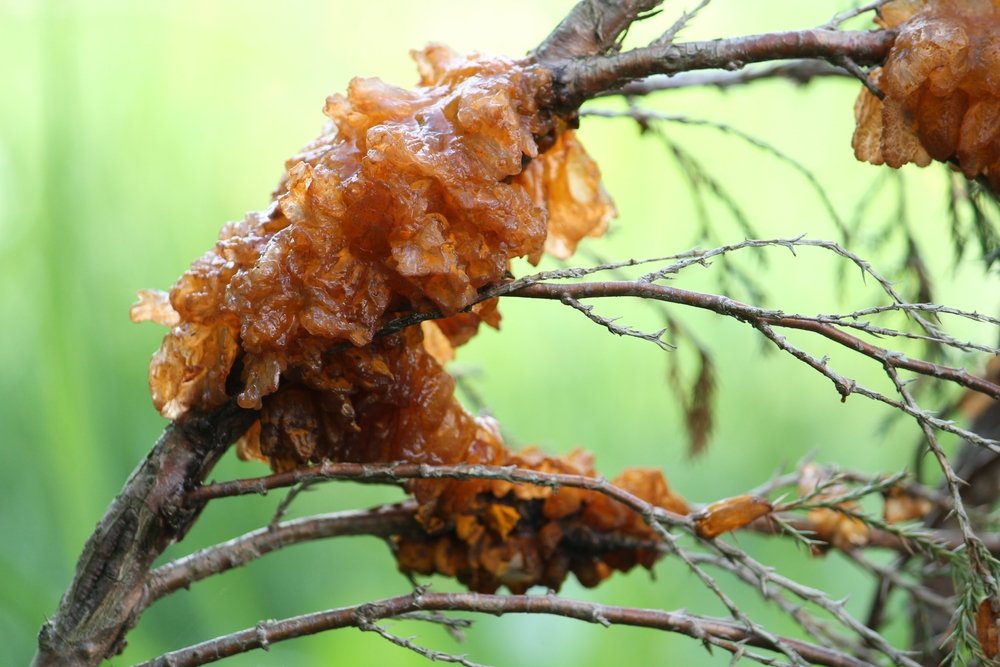
A Reddit user in Oklahoma woke up one morning and found something that confused them. They saw a lot of ‘yellow jelly’ in the trees and saw what they described as a ‘jelly alien nut’ which left them scratching their head.
They turned to Reddit to solve the mystery with the help of the community. They said in the post that the tree was a conifer but they were not sure about the exact name of the tree.
Almost immediately, a user recognized it commonly as ‘cedar-apple rust.’ This rust disease requires two hosts to complete its life cycle. The disease mostly affects apples and crabapples.
The symptoms of this disease on different trees can differ.
On a juniper tree, it appears brown, perennial galls form on twigs. When it matures, it continues to produce orange gelatinous horns during spring when the weather is likely rainy. Sometimes the twig that is beyond the gall dies, but other than that, no other damage occurs to the juniper host.
On an apple or crabapple tree, it appears as circular yellow lesions on the leaves shortly after they bloom. In late summertime, the brownish clusters of threads or cylindrical tubes appear under the spots on the leaves, twigs, or fruits.

In terms of how long the disease lasts, galls appear seven months after the infection first starts. They start to turn into gelatinous masses after 18 months. Then, golf-ball-like depressions appear on the gall, which make way for telial horns the following spring. In the spring rain, the brownish telial horns get longer and turn bright orange. After they release their spores, the horns collapse, dry, and fall off. While the galls then die, they remain attached to the tree for at least another year. The infection is much more obvious in spring when the gall is covered in gelatinous masses.
There are many ways to manage the infection. You can prune off the areas that are infected. You can also leave it alone since it does not kill trees but only disfigured plants where the twigs might be affected. There are also preventative methods; to get preventative fungicides or resistant, apple varieties also exist.
All in all, this does not really affect trees too badly! However, it is important to be aware of it so you know what to do when it pops up in your backyard! Share this with others so they can also know what this infection is!
